3-Jan-2024
Fresh Faces in SCAL’s Council of Management: Charting a New Path Forward
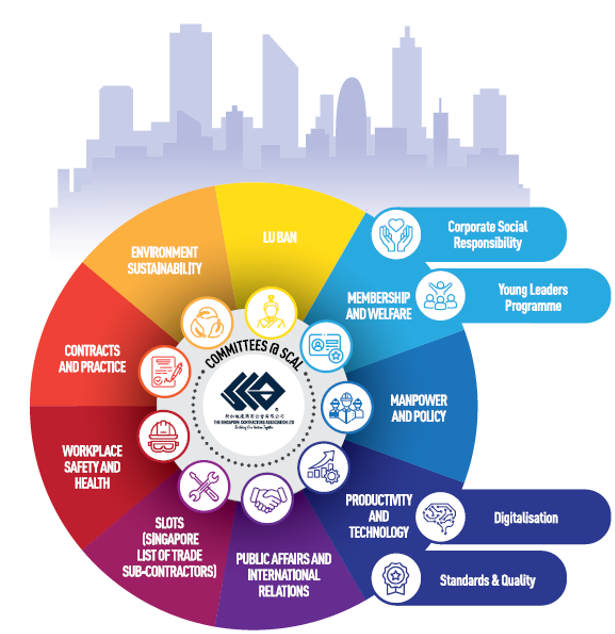
Overview of SCAL committees
During SCAL’s Annual General Meeting in June, batons were passed from outgoing council members to newly elected ones. Comprised of long-time SCAL members as well as new faces, SCAL’s Council of Management for the term 2023 to 2025 presents a diverse mix of experience and perspectives. The younger members, guided by the long-serving members, are expected to contribute fresh takes on the evolving changes that confront the industry. By the same token, they hold a myriad of ambitions and goals that bear the same vision: To lead the construction industry in building a sustainable future for Singapore.
New challenges in the overall business cost trajectory are disrupting the fragile, hard-earned peace and status quo after the pandemic. Through rising materials costs, high inflation, increased manpower costs due to structural shortages, compliance costs, etc., flaws in the old ways of working have once more become apparent. In spite of this, Co-Chair of the Singapore List of Trade Sub-Contractors (SLOTS) Committee Foong Yu Han believes that projects must be done with cost savings in mind, without compromising specifications and qualities required by clients or architects.
If I’m asked to do something, I will not just blindly do it. Including [demands] always has a domino effect. In the end, everything goes back to the consumer. We have to be fair,
she said, adding that the counsel provided by those lower in the “food chain” has proven to be valuable.“
[Subcontractors] are the ones supporting the works for [main contractors]. We are doing the specialised work, they are like the ship captain,” said the Director of Foong Ah Weng Construction, a subcontractor focusing on painting services.
Even if synergies between stakeholders improve, the ongoing manpower crunch has left many projects in a tight spot. Raised levies and reduced manpower quotas with the updates in dependency ratio ceiling have left the industry “squeezed in all directions”. Hiring foreign manpower, an option that was previously perceived as cheaper, came at the cost of project resilience. “We have to look at manpower planning more holistically,” said Andy Lu, Co-Chair of the Manpower and Policy Committee, emphasising that attracting new talent and upskilling existing workers must form the basis of resource planning strategies. Tapping into emerging technologies that seek to improve productivity could be a good start, he added. “At the beginning, it’s going to be costly, right? But sooner or later, there’s going to be a switch. That’s where policy comes in to see how to help the industry,” said Andy who is the Deputy Chief Executive Officer of Wee Hur Construction Pte Ltd.
This shift has begun with digital processes like Building Information Modelling (BIM). With the growing use of such technologies today, it's no surprise that BIM is required in projects.
“We have implemented a lot of software [solutions] in the past two years… whether we can successfully implement them depends very much on end-users,” said Co-Chair of the Contracts and Practices Committee Yheng Yee Foon. As the technological adoption leader and the General Manager of Chuang Hua Construction, Yee Foon has largely introduced mainstream software with the intention to understand how they are utilised by others. “We want to be a better adopter rather than asking vendors to customise to our ‘needs’,” he said, adding that solutions become a “white elephant” when they do not fit into existing company processes. “Our workflow might not be the best, so we want to make it more open… making use of the software’s incumbent functions and [changing our] workflow internally.”
At the current pace, it is possible that there will be fewer people on site 10 years from now, said Seah Kah Howe, Council member of SCAL and Project Director of Seah Kim Cheok Construction Co. (Pte) Ltd. “Our migrant brothers who are building [projects] are starting to use apps more efficiently and they are getting better with smartphones,” he said. Together with a few partners, Kah Howe rolled out Growth Studio a year ago—an application that helps foreign workers learn English. “Improving English communication is one way of ensuring that they know what is the correct material to use, how to use it. And there's no rework. There's no waste of materials,” said Kah Howe.
Concrete, sand, timber – materials derived from natural sources – form the basis of all construction work. Therefore, it is not possible to have “no damage” to the environment when building, said Kah Howe. To be environmentally conscious is to consider ways to minimise material wastage and even reuse it, which points back to fundamental principles of being resource- and cost-efficient. No more, no less.

“If whatever we do is not sustainable for the environment or for the company, [everything] will come to an end some day,” said Joshua Ng, incoming Council Member of SCAL and Deputy General Manager of Wee Guan Construction. With the onset of climate change, environmental sustainability is increasingly becoming an evaluation consideration during tendering processes. While Wee Guan Construction has been committed to sourcing for longer-lasting materials and repurposing used ones, individual efforts are limited. “As a contractor,we need more support from the ecosystem – developers, regulatory bodies and stakeholders—and see how collectively we can contribute to that,” said Joshua.
Given the technical nature of the industry, collaborating to share expertise across the value chain is key to maximising outputs. Taking inspiration from Henry Ford, Joshua said: “I don’t have all the answers, but I know who to find to get them.”
When it comes to specialist knowledge, senior professionals are the most proficient. However, many have expressed their intent to retire, threatening the pool of wisdom available within the construction industry. The concern is compounded by the dwindling pool of civil engineering graduates in Singapore, due to prevailing perceptions that the industry’s salary, work environment, and career prospects are unfavourable. To Koh Zhi Li, incoming SCAL council member and the Contracts Manager of Koh Kock Leong Enterprise Pte Ltd, these are “hygiene factors” that ultimately boil down to a more fundamental question for prospective and existing industry professionals alike: Do employees feel engaged and valued in the construction industry?
“It's a chicken and egg thing … When you have great welfare and people know about it, more will join. And then more young leaders can come forward and create that camaraderie,” he said. As one of the key drivers of SCAL’s Young Leader’s Programme, Zhi Li believes that creating such an environment requires a cultural and mindset shift that “starts from the top”.
“It’s something as simple as sitting your team down, chatting with them one on one, understanding that there are needs at home, and knowing them on a more personal basis,” said Zhi Li. “Conversations can’t just happen by the watercooler or in the lift… it helps you show that you care more at some point.”
At the end of the day, it is the hands behind every project that forms the foundation of the construction industry. Therein lies responsibilities that “cannot be replaced by artificial intelligence” according to Joshua, and a need to be fair to foreign workers who, as Yu Han said, “slogged for hours and hours to build [our] houses”.
As incoming leaders across SCAL’s committees, the responsibility to further nudge the construction industry towards becoming progressive, productive, and professional lies atop these council members’ shoulders. Recent experiences leave us cognisant of the changes needed to be resilient against future disruptions, and it is now imperative to turn words into action. Whether it is putting in place policies that help manpower planning, or accelerating widespread technology adoption to enhance productivity, as Andy put it: “We cannot just brush [these matters] aside or just pay lip service … everyone in the ecosystem needs to do it.”
The article is exrractd from The SCAL Contractor Newsletter - issue 3. Read the full issue in the link
here or click
here to download.